A Cautionary Tale of Over-Exertion


In a bizarre medical case that highlights the unexpected risks of everyday activities, a 54-year-old man was rushed to the emergency room after suffering a severe lung injury while masturbating.
The incident, documented in the Canadian Medical Association Journal (CMAJ), began when the man, feeling a sneeze building, attempted to stifle it by pinching his nose and closing his mouth—a maneuver known as a “valsalva maneuver.” However, he performed this action while simultaneously straining during masturbation.
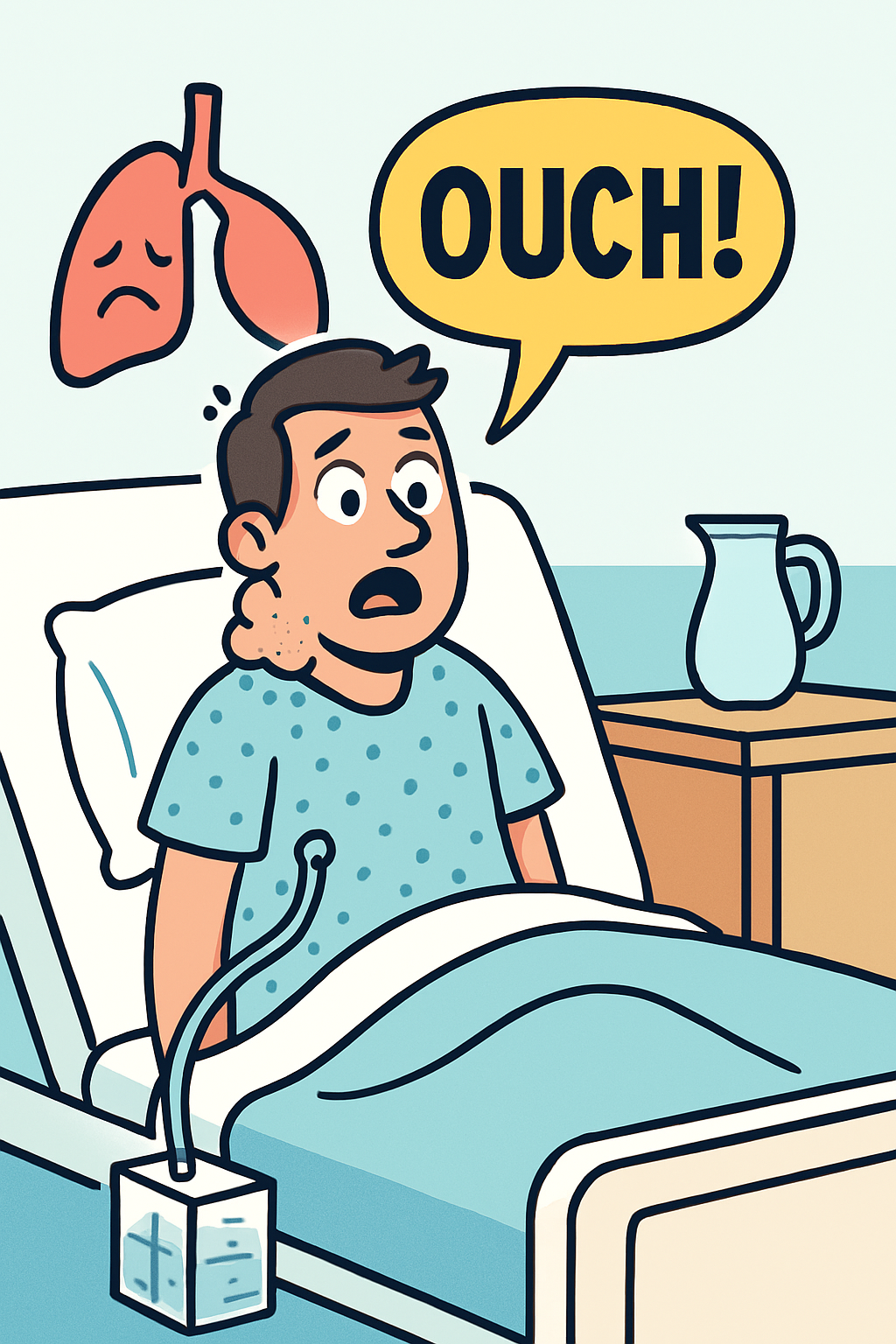
This combination of forceful bodily actions created a perfect storm of internal pressure. The pressure build-up was so intense that it caused his lung to spontaneously collapse—a condition medically known as a “pneumothorax.” The man arrived at the hospital complaining of sharp chest pains, a swollen neck, and difficulty swallowing.
Doctors quickly identified the issue: not only had his lung collapsed, but air had leaked into the space between his lungs and chest wall, and even into the deep tissues of his neck. This condition, called “subcutaneous emphysema,” was the cause of the unusual swelling.
Fortunately, the treatment was straightforward. Doctors inserted a chest tube to re-inflate his lung, a procedure that was successful. After a brief hospital stay for observation, the man made a full recovery.
The case serves as a stark reminder from physicians that holding your breath during strenuous activities, whether lifting weights or during moments of intense physical exertion, can be dangerously stressful on the body. While the circumstances are rare, the underlying principle is a crucial one: the body’s internal systems are not designed to withstand such sudden, high-pressure events.

Related Post

Perineum SunningPerineum Sunning

Wellness influencers swear by the newest craze: perineum sunning. They’re getting some sun where the sun doesn’t shine.

Tanning one’s cans, also known as perineum sunning by influencers, is the hottest wellness trend.

An influencer who goes by the name Ra of Earth states, You will receive more energy from this electric node in a mere 30 seconds of sunlight on your butthole than you would in an entire day being outside with your clothes on. He makes a gesture toward the sun while three naked men lie down, point their backs to the sky, and make sounds of pleasure in a viral video that has received over 35,000 views.

A step-by-step Sun Worship exercise from The Tao of Sexology: has also been posted by Ra of Earth. According to Dr. Stephen T. Chang’s book The Book of Infinite Wisdom, the practice can aid in keeping the area healthy and germ-free.

Earth’s Chang and Ra aren’t the only ones. It appears that other influencers are similarly motivated to take in some of the most vile rays.

[Thirty] seconds of injection of direct sunlight to the anal orifice is equivalent to being outside in the sun for the entire day! Influencer Troy Casey writes.

One Californian claims that taking vitamin D supplements improves her sleep and regulates her hormones.

A picture of a woman who goes by the name Metaphysical Meagan captions it, For the past few weeks I have included sunning my bum and yoni into my daily rising routine. The picture shows the woman completely naked on a rock. Meagan claims that her study of Taoism was the first place she learned about perineum sunning, and she has recently switched from drinking coffee in the morning to sunning her anus.

The peculiarity grabbed the more extensive web’s eye after one Twitter client posted Meagan’s photograph and inscription, to the tune of in excess of 84,000 preferences.

Even celebrities are getting their bums sunbaked. Shailene Woodley, best known for her holistic lifestyle that doesn’t even include a television, has admitted that she has also done perineum sunning.

She told Into The Gloss in 2014, Another thing I like to do is give my vagina a little vitamin D. I was reading an article about yeast infections and other genital problems written by an herbalist I studied. She said that vitamin D is the best thing. If you feel tired, spend an hour in the sun to see how much energy you have. Or, if you live in a region with prolonged winters, spread your legs and enjoy the sunshine when it finally arrives.

Be that as it may, clinical experts are a long way from persuaded the training has any legitimacy.

Dr. Diana Gall of the UK-based online doctor service Doctor 4 U tells Insider, There is no evidence that sunbathing in this manner has any effect on physical well-being.

She asserts, Yes, it is beneficial for mental and physical health to practice mindfulness and meditation and get your vitamin D, but you don’t need to damage your skin in the process from sun exposure.

There are no additional benefits of doing this naked in the sun, according to Gall, who adds that there are different and safer ways to practice mindfulness.

The Federal Trade Commission is having difficulty persuading influencers to shed more light on product endorsements because they are currently letting the sun shine in their back door.

The female insect possesses a protruding genital organ that resembles a penis and is used to penetrate the male’s vagina-like structureThe female insect possesses a protruding genital organ that resembles a penis and is used to penetrate the male’s vagina-like structure

Male barklice of the species Neotrogla have a vagina-like indentation, while their female counterparts have a penis-like structure called a gynosome. This unique genital reversal was studied by a team of entomologists from Hokkaido University, who used micro computer tomography to create 3D models of copulating winged insects from Brazilian caves.

The gynosome is a complex organ with specific muscles and pipes that enable females to attach themselves to males for extended periods of up to 70 hours. One set of muscles unfurls the gynosome, allowing it to enter the male and suck up semen. Another set of muscles then contracts the organ, depositing the sperm into two storage slots inside the female’s body.

The team suggests that the evolution of the female penis was driven by sexual selection, favoring intense female-female competition. The females’ ability to stock up on double the amount of sperm may provide a clue as to why they are so active in their efforts to find semen. The sperm is packaged with nutrient-filled spermatophores, which may serve as a source of nutrition in resource-deprived cave environments.

The lack of reliable food sources in Brazilian caves may have facilitated the evolution of sex-role reversals in the species, where females have a greater incentive to seek out and consume nutrients through their copulatory behavior.

Shocking Ultrasound Reveals Microscopic Worms in Man’s Scrotum: Unearthing a Rare InfectionShocking Ultrasound Reveals Microscopic Worms in Man’s Scrotum: Unearthing a Rare Infection

A disturbing video captures the moment when an ultrasound examination uncovered minuscule worms wriggling inside a man’s scrotum. The 26-year-old individual, hailing from New Delhi, India, sought help at a sexual health clinic due to discomfort and swelling in his right testicle.

To the astonishment of doctors, the ultrasound revealed the presence of “linear structures in motion” within a narrow tube responsible for transporting fluid and white blood cells in the scrotum. The patient, who remained unnamed, received a diagnosis of lymphatic filariasis and was prescribed a three-week course of an anti-parasitic medication. Upon his return, the worms had vanished.

This unsettling case follows a previous incident in which a Venezuelan man sought medical attention after claiming that thieves inserted a beer bottle into his rectum.

Dr. Amit Sahu, a senior medical consultant at Max Super Speciality Hospital who examined the patient, noted that the ultrasound displayed “the undulating movements of live worms.” These worms had migrated into the lymphatic system, leading to dilation and dysfunction of the channels.

Further examination involved the extraction of fluid from the scrotum, which, when examined under a microscope, also revealed a multitude of live worms scientifically known as Wuchereria bancrofti, thus confirming the diagnosis. The patient was subsequently treated with diethylcarbamazine, a potent anti-parasitic drug effective against the worms.

Upon returning for a follow-up three weeks later, another ultrasound confirmed the absence of the worms, and the patient experienced a full recovery.

Lymphatic filariasis infections are typically transmitted through mosquito bites, as these insects transfer the parasites into the bloodstream. Once in the bloodstream, the worms travel into the lymphatic system, a network designed to drain fluid, eventually reaching various parts of the body, including the scrotum.

Within the lymphatic system, these parasites mature, reproduce, and release millions of offspring. Usually, these worms do not trigger any noticeable symptoms. However, in certain cases, damage to the lymphatic system leads to fluid accumulation in the legs, resulting in lymphedema. In more severe instances, characterized by substantial limb swelling, individuals are diagnosed with elephantiasis. In men, the presence of these parasitic worms can lead to genital swelling, which, in extreme cases, causes disfigurement and mobility problems.

The primary treatment for this disease involves antiparasitic medications. Lymphatic filariasis infections are relatively common in tropical and subtropical regions, including parts of Africa, Asia, and South America. These infections are not present in the United States or the United Kingdom.

The Centers for Disease Control and Prevention (CDC) emphasize that individuals need to be repeatedly bitten by infected mosquitoes over several months to contract the infection. Short-term tourists have a very low risk of infection. However, people residing in tropical or subtropical areas where the disease is prevalent face the greatest risk.

The World Health Organization (WHO) classifies lymphatic filariasis as a neglected tropical disease. Estimates suggest that over 50 million people worldwide are infected with this disease. Nevertheless, the WHO asserts that the disease could be eradicated if annual doses of anti-parasitic drugs were distributed to at-risk regions.