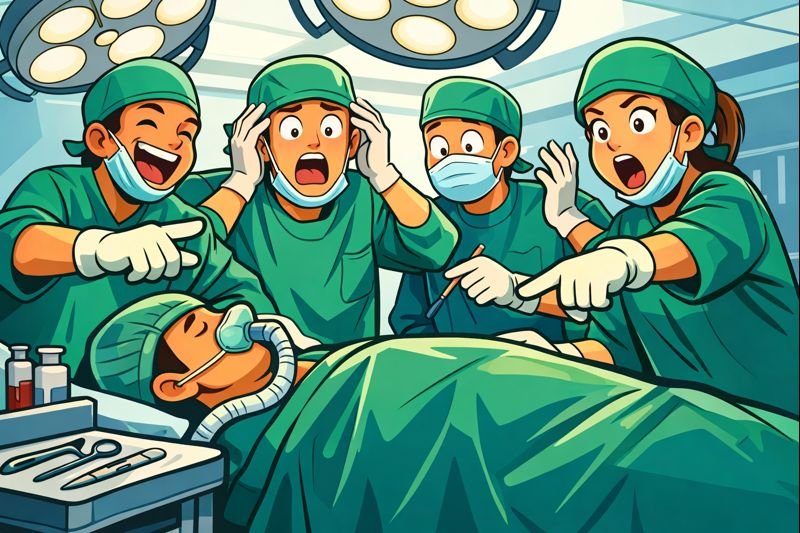

A New Beginning: The Story of the First U.S. Penis Transplant Patient


In a groundbreaking medical milestone, a team of surgeons at Massachusetts General Hospital has successfully performed the United States’ first penis transplant, offering a profound new hope for a patient whose life was irrevocably changed by cancer.
The recipient, a 64-year-old man from Halifax, Massachusetts, underwent a 15-hour procedure in mid-May. The transplant was not for erectile dysfunction, but to reconstruct his genitals after a life-saving surgery for advanced penile cancer several years prior. The amputation, while necessary, came at a significant psychological cost, leaving him with deep feelings of incompleteness and isolation.
“For this patient, it was about restoring a fundamental part of his identity,” explained Dr. Curtis Cetrulo, a leading member of the transplant team. “We are venturing beyond simply saving lives into the realm of restoring a sense of normalcy and wholeness.”
The procedure is exceptionally complex, requiring the meticulous reconnection of tiny nerves, blood vessels, and tissue from a deceased donor. The ultimate goal is for the patient to regain not only the physical appearance but also urination function and sexual sensation. The medical team is cautiously optimistic, citing the success of a similar, smaller-scale surgery performed in South Africa in 2014.
The patient, who has chosen to remain anonymous to protect his privacy, expressed immense gratitude. His hope is simple yet powerful: to one day regain a “normal life.” For him, success would mean the ability to urinate standing up and to feel whole again, both physically and emotionally.
This transplant represents more than a single patient’s journey; it opens a new frontier in reconstructive surgery. The team at Mass General believes this procedure could eventually help other men who have suffered severe genital trauma from accidents on the battlefield, car crashes, or other cancers.
The road to recovery is long, requiring extensive monitoring to prevent organ rejection and intensive physical therapy. But for the first man in the U.S. to undergo this pioneering procedure, it is a path he walks with renewed hope, symbolizing a powerful step toward healing the visible and invisible scars of disease.


Related Post

Born Without An AnusBorn Without An Anus

A baby boy in Pakistan was born with an incredibly rare medical condition known as diphallia, which means he has two working penises but no anus. According to a team of researchers who published their findings in the International Journal of Surgery Case Reports, the chances of being born with this condition are one in six million. Diphallia can present as complete or incomplete and is often associated with complex urological, gastrointestinal, or anorectal malformations.

The abstract of the study revealed that the boy’s penises were both normal-shaped, with one being slightly larger than the other at 2.5 cm and 1.5 cm in length, respectively. The boy had two separate urethral orifices, and both phalluses had normal-shaped glans with urethral openings located in the typical position. He had a single scrotum with two midline raphe and well-formed rouge. The boy was passing urine from both orifices, and an ultrasonography of his urological system showed two ureters and a single hemi bladder.

After being admitted to the hospital, the baby boy underwent surgery, and a sigmoid-divided colostomy was constructed. During the operation, the doctors also identified a congenital pouch colon. To enable the baby to pass stools, the doctors created an opening via a colonoscopy.

Crack That CockCrack That Cock

During “vigorous” sex with his wife, an Indonesian man snapped his penis.
While his lover was in the cowgirl position, the 44-year-old Bali man heard “a crack,” which was followed by excruciating pain.

When his penis slipped out while she was on top of him, she fell on top of it with her perineum, which is the area between her vagina and anus.

His erection ended right away, and horrifying images show his penis hanging at an angle.
After waiting three hours before going to the hospital, the unidentified man became concerned when his penis began to swell and blood began to leak from the tip.

To examine the injuries, doctors were forced to “de-glove” his penis, which means peeling off the skin.
They discovered a one-inch (3 cm) fracture in the spongy tissue that swells with blood during an erection in the shaft of the penis. Additionally, he broke his urethra.
Sanglah General Hospital doctors wrote about the incident in the International Journal of Surgery Case Reports.

Penis fractures are uncommon injuries that necessitate immediate treatment when they do occur.
It usually takes place during sex, and the most common positions are “doggy style,” in which the man is behind the woman, and “cowgirl.”

The man went to the emergency room shortly after the accident, where doctors inserted a thin, flexible camera into his penis to look at the damage.

The man’s urethra, the tube inside the penis that allows urine to leave the body, was ruptured, they discovered.

After degloving the penis, they rushed him to surgery and discovered the fracture.
The man was given an erection using drugs to ensure that no blood would leak out after the break was stitched back together, and his penis was carefully bandaged.

Following a 21-day time span, the 44-year-old purportedly made a full recuperation and had the option to keep an erection and pee regularly.

One of the doctors who treated the man, urologist Dr. Muhlis Yusuf, said that different sexual positions could cause penis fractures.

They wrote in the case report, “‘ Doggy style was the most common vigorous sexual position.
‘Another concentrate likewise revealed that penile crack generally happens assuming the lady is in a predominant position.’

Dr. Yusuf went on to say that men’s embarrassment over the injury might cause them to delay seeking treatment, which could make these kinds of injuries worse.

The man’s injuries were not detailed by the medical professionals.

Although the man made a full recovery and was able to have sex again without pain, the case report did not specify whether he was given antibiotics or painkillers during his recovery.

It likewise didn’t make sense of if the stiches the man was given during his medical procedure were dissolvable or they should have been taken out sometime in the future.

City Pays $15 Million After Police Encounter Goes Shockingly AwryCity Pays $15 Million After Police Encounter Goes Shockingly Awry


In a settlement that underscores the extreme consequences of police tactics, a city has agreed to pay $15 million to a protester who suffered a devastating injury when a police projectile ruptured one of his testicles.
The incident occurred during a period of civil unrest. The man, participating in a protest, was struck by a less-lethal round fired by an officer. The impact did not just cause a severe bruise; the force was so significant that it caused one of his testicles to explode, requiring immediate surgical removal.
The graphic nature of the injury became a central point in the subsequent lawsuit, which accused the city and its police department of excessive force. After years of legal battle, the city council voted to approve the massive settlement to avoid a trial.
While the financial compensation is substantial, the plaintiff’s attorneys emphasized that no amount of money can undo the permanent physical and emotional trauma their client endured. The case serves as a stark, and frankly shocking, reminder of the potential for life-altering injury inherent in certain police crowd-control methods.