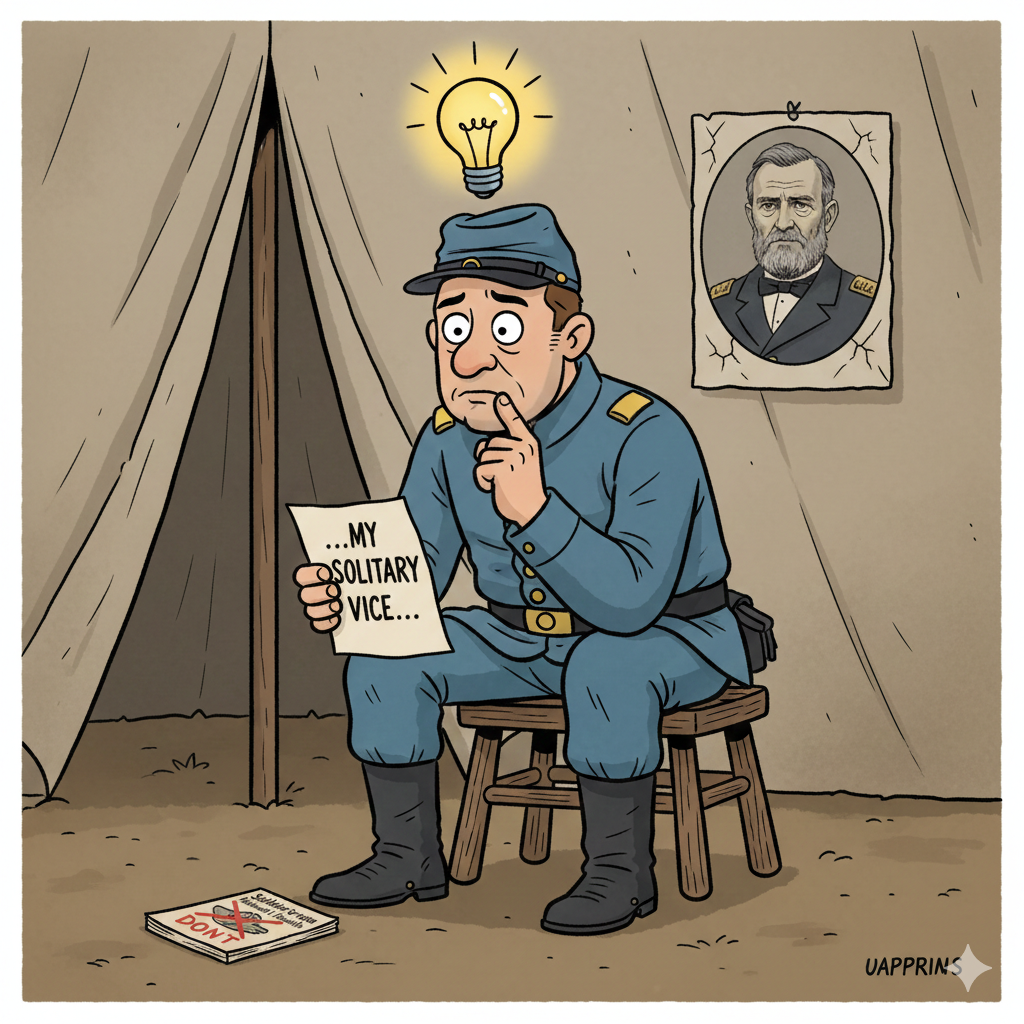
Civil War Letter Reveals Soldier’s Taboo Addiction to Masturbation

A recently surfaced 1864 letter provides a glimpse into a little-discussed affliction among Civil War soldiers – chronic masturbation.

The handwritten note by Confederate Lt. William Dandridge Pitts inquires about the condition of his brother Charles, who was discharged from the army in 1862 due to an unspecified “illness.” Charles was residing at the Western Lunatic Asylum in Virginia.

According to Charles’ doctor and accounts from fellow soldiers, his illness was a relentless addiction to masturbation. “I have had some conversation with the physician who attended my brother previous to his going to the asylum,” Lt. Pitts wrote, “and he advises me…that [Charles] was addicted to masturbation, while in camp.”

The letter highlights the mental health toll of the war, even before combat began. Soldiers forced to endure their comrades’ “self-pollution” no doubt developed deep psychological scars.

While masturbation remained taboo in the Victorian era, it was pervasive enough in the military to earn the nickname “Johnny Reb.” The irony of this affliction among troops from Virginia, the “state for lovers,” was surely not lost on the Pitts family.

The letter survives in excellent condition despite its delicate subject matter. This “director’s cut” offers intimate insight into secret struggles in Civil War ranks.

Related Post

Florida Man Sexually Abused a Goldendoodle in Front of Multiple Witnesses an then destroyed a Church Nativity SceneFlorida Man Sexually Abused a Goldendoodle in Front of Multiple Witnesses an then destroyed a Church Nativity Scene

A man in Florida was arrested for allegedly sexually abusing a dog in front of several families before damaging a nativity display at a church and attempting to steal a car. Chad Albert Mason, 36, was charged with one count of sexual activity involving an animal, two counts of exposing sexual organs, and two counts of lewd or lascivious exhibition. Police were alerted about the sexual activity involving animals after receiving multiple 911 calls on Sunday. Mason allegedly inserted his penis into the dog’s anus and performed a sex act in front of numerous adults, including a child. He fled after being confronted by an adult. Police later found him and took him into custody. Mason is also accused of destroying the nativity scene at Northwood Presbyterian Church, causing $400 worth of damage. He was released on bond and is scheduled to appear in court next week.

Home care worker puts penis in resident’s mouth for ‘comfort’Home care worker puts penis in resident’s mouth for ‘comfort’

A court has heard that a care home worker sexually assaulted a vulnerable resident in order to “comfort” her.

The accused, Samuel Shaheen, reportedly repeatedly kissed the woman, touched her breasts and buttocks, and inserted his penis in her mouth while assuring her that it was their “little secret.” According to prosecutor Ian Wright, Shaheen, who was a qualified nurse in his home country, was working as a care assistant at a residential home in Neath Port Talbot when he committed the acts. He allegedly carried out the sexual assaults on multiple occasions, with the victim being a woman with various physical and psychiatric health issues.

The court was told that the 46-year-old carer instructed the woman not to tell anyone about their secret and showed her photographs of his wife and children in Pakistan. Shaheen said that his wife was his “number one” but the victim was his “number two.”

The victim did not report the abuse for some time but eventually went to the care home manager, and the police were notified. Shaheen was arrested at his sister-in-law’s house in Newport and admitted to the sexual acts in interviews, claiming that they had been consensual. He then said that he had been acting out of kindness in providing “comfort” to the woman with his kissing and touching.

In an impact statement read to the court, the victim said that the abuse had left her feeling like she could no longer trust anyone, and she believed the experience had worsened her mental health.

Judge Christopher Vosper KC found that Shaheen had groomed the woman and taken advantage of her to carry out sexual acts. He also noted that the victim had been too afraid to report the abuse. The judge expressed concern about Shaheen’s lack of appreciation for the severity of his actions and the possibility of future offenses.

Shaheen was sentenced to four years in prison, with a one-third discount for his guilty pleas. He will serve up to half that period in custody before being released on license to serve the remainder in the community. He will also be on the sex offenders register for the rest of his life and subject to an indefinite sexual harm prevention order. The judge warned that Shaheen might be detained in an immigration center when he is released halfway through his sentence.

Religious Leader Claims Beards Are a Moral Safeguard Against ‘Indecent Thoughts’Religious Leader Claims Beards Are a Moral Safeguard Against ‘Indecent Thoughts’

A religious leader has sparked debate by stating that men who are clean-shaven may inadvertently cause “sinful and indecent thoughts” in others, arguing that facial hair is a God-given feature meant to distinguish gender and promote modesty.
The comments were made by Pastor Gary Mooibroek of the Reformed Congregation in the Netherlands. In a sermon, he suggested that a beard serves as a natural barrier to immoral thinking. He posited that the act of shaving removes a divine distinction between men and women, potentially leading to confusion and temptation.
“God gave men beards for a reason,” Mooibroek stated. “It is a clear sign that he is a man. When a man shaves his beard, he removes that sign. This can lead to sinful thoughts, because the clear distinction is blurred.”
The sermon, which circulated online, has drawn a mix of reactions. Some within his congregation have supported the view, seeing it as an extension of their faith’s emphasis on clear gender roles and modest appearance. However, critics have labeled the remarks as archaic and potentially harmful, arguing that they promote superficial judgments and place an unreasonable burden of responsibility on men for the thoughts of others.
This is not the first time conservative religious interpretations of appearance have made headlines. Similar discussions have arisen regarding standards of dress for women. Mooibroek’s comments highlight the ongoing tension between traditional religious beliefs concerning physical appearance and modern societal norms.